10 Steps to Repair American Democracy by Steven Hill
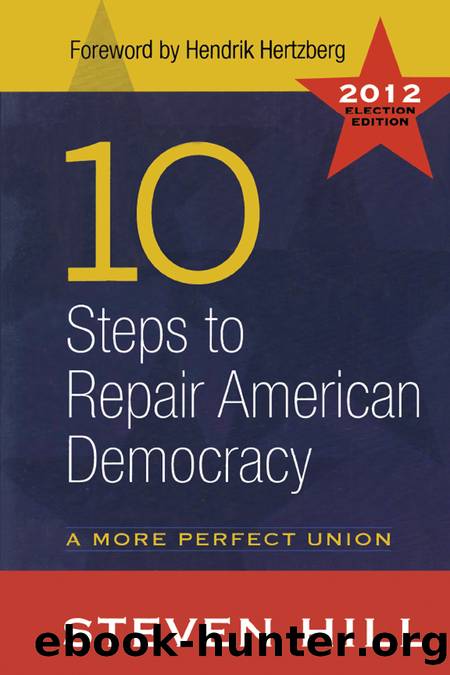
Author:Steven Hill [Hill, Steven]
Language: eng
Format: epub
Tags: Social Science, Political Science, Sociology, Politics, General
ISBN: 9781612051925
Google: E0ceCwAAQBAJ
Amazon: 1612051928
Goodreads: 28133025
Publisher: Routledge
Published: 2006-05-01T00:00:00+00:00
CORPORATE MEDIA SUBSIDIES VERSUS THE PUBLIC INTEREST
While steamrolling over Lilliputian, community-based microradio, corporate broadcasters benefit from a nearly $400 billion government subsidy that hands over control of the publicâs airwaves to them for free.11 When the Communications Act of 1934 granted broadcasters free and exclusive licenses to the public airwaves, it did so on the condition that they agreed âto serve the public interest.â So what have the broadcasters done with their commitment to the public interest?
For starters, they have reduced their political coverage. Robert Lichter of the Center for Media and Public Affairs said his organizationâs study of the 2000 election showed that âtwo elections ago the three networks together gave you about 25 minutes a night of election news, or about eight minutes apiece. [In the 2000] election they gave you about 12 minutes, or four minutes apiece per night.â12 Of that reduced amount of election news, an average of only sixty-four seconds per night was quality time with the candidates discussing issues or their views. The rest was âhorse raceâ speculation about who might win the election.13 In addition, since 1968 the average presidential campaign sound bite on network news had declined from 43 to 8.2 seconds. Gary Ruskin, director of Commercial Alert, commented, âThird graders communicate in longer segments than that.â14 Astoundingly, Lichter discovered that presidential candidate George W. Bush received more airtime in a single guest appearance on the Late Show with David Letterman than he received during all of October 2000 on all three network newscasts combined.15
Reduced political coverage has meant that, increasingly, politicians in a campaign season have no choice but to buy more television ads, generating a gold mine of revenue for the media conglomerates. Political TV ads brought broadcasters over $2 billion in revenue in 2010, and this figure is predicted to rise to $2.7 billion in the 2012 presidential election year.16 Though they only appear for a few months out of the year, political commercials typically are the third-largest source of TV advertising revenue for broadcasters, trailing only automotive and retail ads.17 Some media analysts contend that this has led to a brazen bottom-line move on the part of television broadcasters: decrease political coverage, forcing candidates to buy more TV time. This means that broadcasters are selling back to candidates the airwaves they have been given for free by the public.
In addition, broadcasters are actively gouging campaigns during the political season, especially as Election Day approaches and campaigns are frantically trying to spread their message. It is not uncommon for prices for TV spots to double and triple, sometimes within hours. One consultant from a firm handling congressional races reported how a Philadelphia station quoted a $900 price for a particular TV slot. âWhen my buyer called a few hours later to place the ad, she was told, sorry, the price is now up to $1,150.â In Portland, Oregon, the Sierra Club found that the price of a thirty-second spot more then tripled in less than one month. A Brigham
Download
This site does not store any files on its server. We only index and link to content provided by other sites. Please contact the content providers to delete copyright contents if any and email us, we'll remove relevant links or contents immediately.
The Secret History by Donna Tartt(19090)
The Social Justice Warrior Handbook by Lisa De Pasquale(12190)
Thirteen Reasons Why by Jay Asher(8912)
This Is How You Lose Her by Junot Diaz(6887)
Weapons of Math Destruction by Cathy O'Neil(6281)
Zero to One by Peter Thiel(5802)
Beartown by Fredrik Backman(5755)
The Myth of the Strong Leader by Archie Brown(5508)
The Fire Next Time by James Baldwin(5446)
How Democracies Die by Steven Levitsky & Daniel Ziblatt(5219)
Promise Me, Dad by Joe Biden(5154)
Stone's Rules by Roger Stone(5088)
A Higher Loyalty: Truth, Lies, and Leadership by James Comey(4964)
100 Deadly Skills by Clint Emerson(4926)
Rise and Kill First by Ronen Bergman(4789)
Secrecy World by Jake Bernstein(4753)
The David Icke Guide to the Global Conspiracy (and how to end it) by David Icke(4720)
The Farm by Tom Rob Smith(4514)
The Doomsday Machine by Daniel Ellsberg(4490)
